


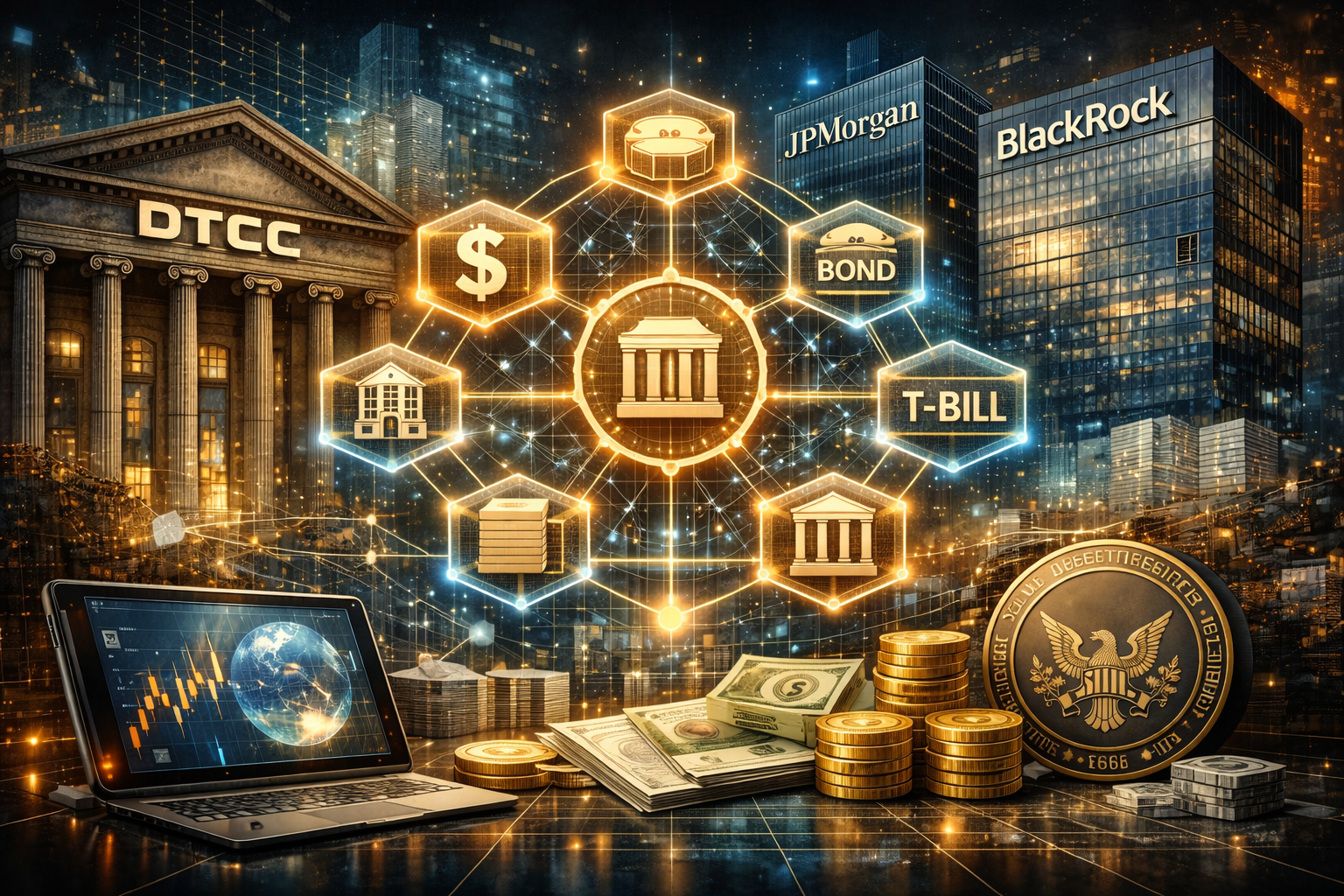
A new SEC no-action pathway for DTCC tokenization services, plus fresh institutional products from JPMorgan and BlackRock, suggests 2026 could be the year tokenized “real-world assets” move from pilots to plumbing.
Tokenization—the process of representing traditional assets as digital tokens recorded on blockchain or other distributed ledger technology (DLT)—has spent the past few years oscillating between big promises and small pilots. That balance is starting to shift. Over the last month, a cluster of developments has brought tokenization closer to the center of market infrastructure: U.S. clearing and settlement rails are testing regulated tokenized “entitlements,” major banks are rolling out tokenized fund products, and tokenized cash and Treasury vehicles are being treated less like experiments and more like reusable collateral.
DTCC’s SEC-backed opening: tokenized “entitlements,” not a parallel stock market
The most consequential signal is coming from the clearing layer. DTCC says its Depository Trust Company (DTC) has been authorized to offer a tokenization service for select DTC-custodied assets after receiving SEC staff no-action relief dated December 11, 2025—a meaningful regulatory step because DTC sits at the heart of U.S. securities settlement.
Rather than proposing a brand-new marketplace, the design focuses on recording security entitlements using DLT as an alternative representation of what is already held at DTC. A legal analysis of the SEC staff letter describes a limited, voluntary, three-year pilot where DTC participants can elect to have entitlements recorded using DLT (“tokenized entitlements”) instead of only via DTC’s current book-entry ledger. This framing matters: it targets a narrow but foundational problem—how ownership claims and transfers are recorded and reconciled—without immediately attempting to rebuild listing venues, broker rules, or issuance regimes from scratch.
If tokenization is going to scale, plumbing beats hype. Settlement is where costs, operational risk, and timing frictions accumulate. By trying tokenized records under an SEC-acknowledged pathway, DTCC’s move signals that regulators and incumbent infrastructure are increasingly willing to test DLT in production-adjacent settings, with defined controls and known participants. DTCC itself is positioning the service as a way to support “evolving capital markets with secure tokenization,” emphasizing custody-anchored assets and participant access rather than open, permissionless trading.
Wall Street is tokenizing funds—because funds are where the bottlenecks are
While DTCC works on “rails,” banks and asset managers are working on “vehicles.” Tokenized funds have become a practical wedge: they’re familiar to institutions, are often restricted to qualified investors, and can deliver immediate operational advantages (faster movement, programmability, and collateral utility) without requiring retail-facing reinvention.
JPMorgan is one of the most visible examples. Reporting in late 2025 described the bank tokenizing a private-equity fund on its own blockchain initiative and planning a broader rollout of its fund tokenization platform in 2026. Coindesk similarly reported that JPMorgan completed an early blockchain-based private fund transaction tied to its tokenization push. The through-line is clear: tokenization isn’t being pitched as “crypto for everything,” but as an operational layer for alternative and fund products that are already illiquid, slow to settle, and expensive to service.
Tokenized money-market products are also expanding beyond a single firm’s sandbox. Investopedia reported that Goldman Sachs and BNY Mellon moved to support tokenized versions of money market fund processes via BNY’s LiquidityDirect platform integrating with Goldman’s blockchain (GS DAP), creating a controlled environment where official records remain traditional while “mirror tokens” exist on-chain. That structure—traditional recordkeeping plus on-chain representations—mirrors the cautious approach visible in DTCC’s entitlement framing: add DLT utility without blowing up existing legal and operational anchors.
BlackRock’s BUIDL: tokenized T-bills as reusable cash-like building blocks
On the asset manager side, BlackRock’s tokenized Treasury fund has become a reference point for institutional tokenization at scale. A PRNewswire release described BlackRock’s USD Institutional Digital Liquidity Fund (BUIDL), tokenized by Securitize, as a product designed for qualified investors with features like flexible custody, dividend payouts, and near-real-time peer-to-peer transfers.
More recently, reporting highlighted that BUIDL distributed significant yield payouts (framed as a real-world test of blockchain-based infrastructure) as tokenized Treasury products continue to proliferate. The story here is less about novelty and more about function: tokenized T-bill exposure can behave like “programmable cash”—something institutions can move, pledge, and re-use around the clock, including in workflows that resemble (but are not identical to) crypto collateral mechanics.
That “reusability” is also showing up at the interface between centralized venues and tokenized assets. The Economic Times reported that Binance began supporting BlackRock’s BUIDL as off-exchange collateral for trading, aimed at improving collateral management for institutional clients without requiring assets to sit directly on the exchange. Whether or not a given institution uses Binance, the pattern matters: tokenized money-market/Treasury products are becoming modular collateral components, not just passive holdings.
Why tokenization is suddenly “real”: three forces converging
These developments point to a more mature tokenization narrative than the one that dominated early cycles. Three forces are converging:
- Regulatory-adjacent infrastructure pilots. DTCC’s SEC no-action framework—paired with the controlled, time-boxed pilot described by legal analysis—reduces the “unknown unknowns” that kept many institutions on the sidelines.
- Products that fit institutional constraints. Tokenized funds and cash-equivalents let firms innovate inside familiar wrappers: qualified investor rules, custody expectations, and audited workflows.
- Collateral utility and settlement logic. Tokenization delivers the most value when it improves movement and reconciliation—settlement, pledging, re-hypothecation controls, and reporting—rather than when it simply recreates a stock certificate as a JPEG on-chain.
In practice, tokenization is increasingly being used to answer questions financial institutions care about: Can we shorten settlement time? Can we reduce failed trades? Can we automate corporate actions and entitlement checks? Can we treat a cash-like asset as programmable collateral with better auditability?
The “RWA” story broadens beyond banks: public networks chase compliant scale
Public blockchain ecosystems are also competing to host tokenized real-world assets (RWAs) by emphasizing compliance and institutional integrations. For example, one recent report said the Stellar network surpassed $1 billion in tokenized RWAs, citing partnerships and positioning around compliance-friendly infrastructure. (As with many ecosystem reports, the most reliable takeaway is directional: multiple chains are now competing on regulated asset tokenization rather than purely retail crypto use cases.)
What remains hard: standards, interoperability, and legal harmonization
Even with momentum, tokenization is not a flip-the-switch upgrade. The biggest remaining hurdles are boring and difficult:
- Standardization: token formats, transfer restrictions, identity/whitelisting schemes, and corporate action handling must be consistent across providers to avoid recreating fragmented silos.
- Interoperability: if tokenized funds live on one set of rails and tokenized entitlements on another, institutions will demand bridges that preserve compliance and auditability.
- Jurisdictional rules: tokenization touches securities law, custody, bankruptcy treatment, and settlement finality—areas where cross-border inconsistencies can create real risk.
This is why the most credible near-term path looks hybrid: traditional legal anchors plus tokenized representations that deliver operational advantages while regulators and infrastructure providers learn what breaks (and what doesn’t) in production.
The 2026 outlook: from “tokenized assets” to “tokenized workflows”
If 2024–2025 was about proving tokenized assets could exist, 2026 is shaping up to be about proving tokenized workflows can run reliably: issuance-to-custody-to-collateral-to-settlement, with clear oversight and measurable benefits. DTCC’s no-action-backed pathway puts regulated market infrastructure into the tokenization conversation at a deeper level than conference panels. Meanwhile, JPMorgan’s tokenized fund efforts and the growing ecosystem around tokenized money market/Treasury products show that institutions are actively testing how tokenization changes liquidity management, distribution, and collateral operations.
That doesn’t mean tokenization will erase traditional finance. It does suggest that, step by step, tokenization is becoming less of a speculative bet and more of a set of tools financial incumbents are willing to operationalize—especially where it reduces friction, improves transparency, and makes capital more mobile under controlled rules.
