


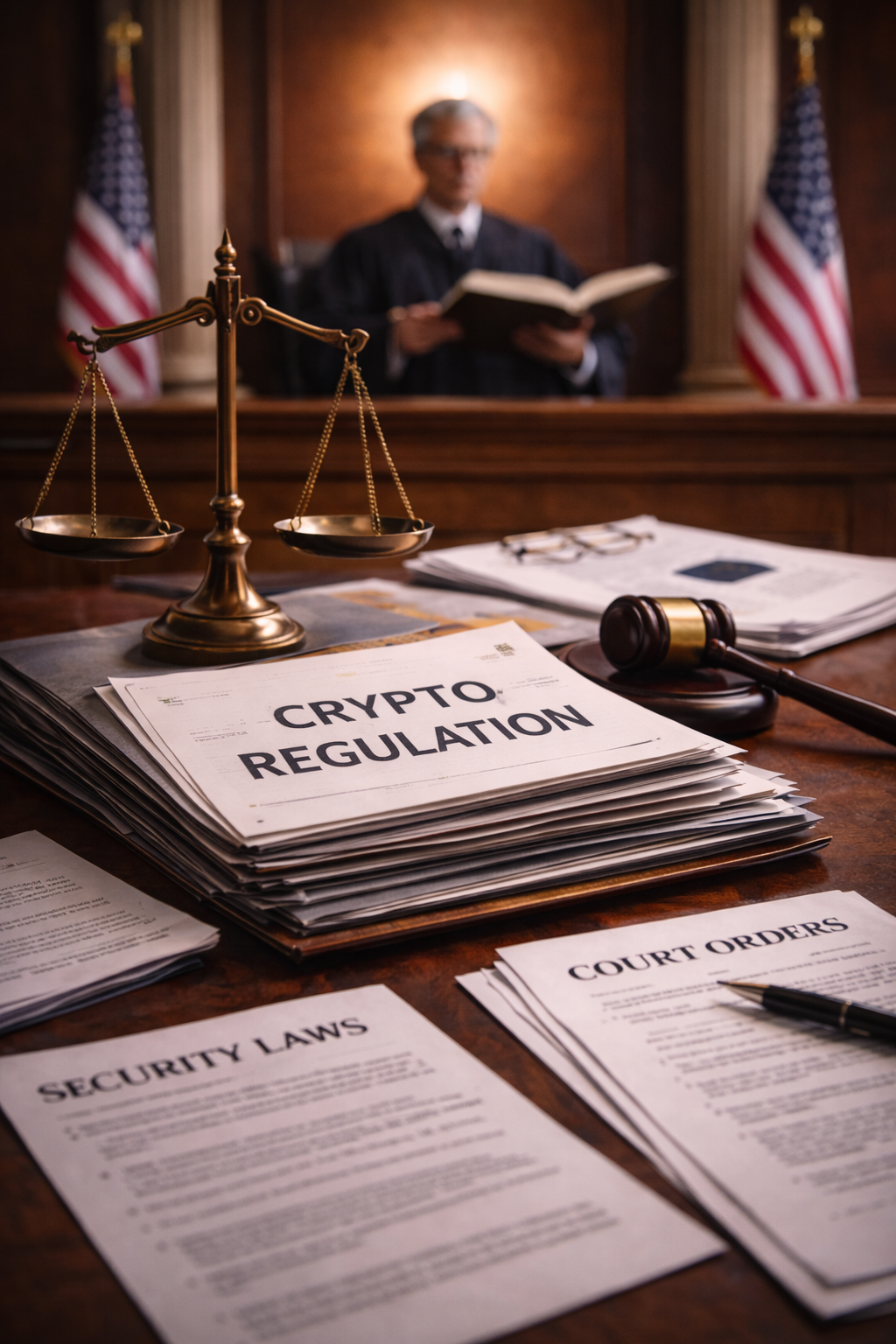
In the United States, much of the practical regulation of digital assets is being determined not by Congress, but by the courts. While lawmakers continue to debate comprehensive crypto legislation, judges are increasingly being asked to decide how existing securities and commodities laws apply to blockchain-based assets and services.
This dynamic has placed the judiciary at the center of crypto regulation, with court rulings effectively setting boundaries for regulators, exchanges, and token issuers.
Regulation by Litigation
Federal agencies such as the Securities and Exchange Commission (SEC) and the Commodity Futures Trading Commission (CFTC) have largely pursued enforcement-based approaches to crypto oversight. Rather than issuing new, bespoke rules, regulators have relied on lawsuits and settlements to assert how decades-old statutes apply to modern digital assets.
In these cases, courts are tasked with interpreting whether certain crypto assets qualify as securities, whether platforms must register as exchanges or brokers, and how disclosure obligations should apply. These rulings often hinge on interpretations of the Supreme Court’s long-standing Howey test, which defines an “investment contract.”
Why Courts Matter More Than Congress—for Now
Congress has introduced multiple bills aimed at clarifying crypto regulation, but none have yet established a comprehensive framework. In the absence of legislative clarity, courts become the venue where legal definitions are tested and refined.
Judicial decisions can:
- Limit or expand regulatory authority
- Clarify compliance obligations for companies
- Influence how future enforcement actions are structured
While court rulings do not create new laws, they establish precedents that shape regulatory behavior and industry practices.
Implications for the Industry
For crypto companies, court-driven regulation creates both risk and opportunity. On one hand, litigation introduces uncertainty and legal costs. On the other, favorable rulings can provide clarity that legislation has failed to deliver.
For investors, court decisions often act as market catalysts, triggering price movements when enforcement actions are upheld or challenged. Over time, these rulings collectively form a patchwork regulatory environment that companies must navigate carefully.
Until Congress acts decisively, courts are likely to remain the primary forum where the rules of crypto markets are defined.
Sources & References
- U.S. Supreme Court, SEC v. W.J. Howey Co.
- SEC enforcement releases
- Reuters reporting on crypto-related court rulings
