


tone of the most important questions facing blockchain technology.
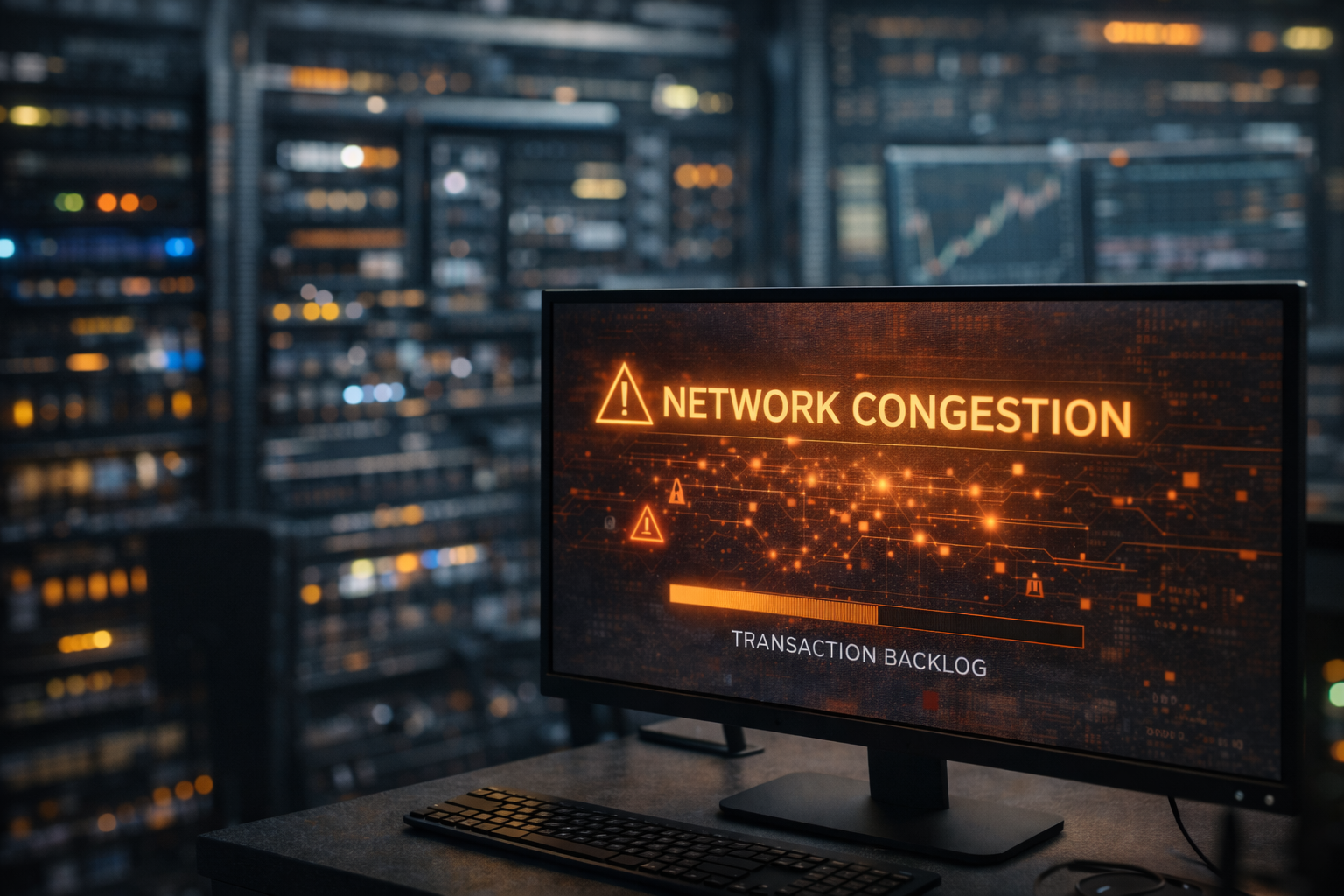
For now, recent market activity has reinforced a familiar lesson: technological progress has Blockchain networks are once again confronting a familiar challenge: congestion during periods of heightened market activity. As crypto markets have reacted to shifting macroeconomic expectations and bursts of volatility, transaction volumes on several major networks have spiked, leading to higher fees and slower confirmation times.
These conditions have renewed attention on scaling upgrades that developers have been working toward for years. While recent improvements have reduced costs compared with earlier market cycles, network stress tests over the past several months have highlighted the limits of current capacity and the uneven progress of scaling solutions.
According to Reuters, periods of sharp market moves frequently coincide with increased on-chain activity, as traders reposition, liquidations occur, and arbitrage opportunities emerge across exchanges (https://www.reuters.com/technology/cryptocurrency/). The result is a real-world test of whether recent technological upgrades can handle sustained demand.
What Happened During Recent Market Spikes
During several recent bouts of volatility, users reported elevated transaction fees on major blockchain networks, particularly during peak trading hours. While average fees remained below the extremes seen during earlier bull markets, the increase was noticeable enough to draw user and developer attention.
On Ethereum, for example, transaction fees rose as decentralized finance activity increased alongside market swings. Data tracked by blockchain analytics platforms shows that average gas prices tend to rise sharply during liquidation events and rapid price movements, when many transactions compete for limited block space.
Reuters has previously reported that congestion-driven fee spikes can discourage smaller transactions and push activity toward centralized exchanges or alternative networks during volatile periods (https://www.reuters.com/markets/).
Why Congestion Still Occurs
At a technical level, congestion is a consequence of design trade-offs. Blockchains prioritize decentralization and security by limiting how much data can be processed in each block. This ensures that the network remains accessible to a broad range of participants but constrains throughput.
When demand exceeds capacity, users bid for inclusion by paying higher fees. This market-based mechanism allocates scarce block space but can price out lower-value transactions.
The persistence of congestion underscores that scaling is not a single upgrade but an ongoing process involving multiple layers of the network.
The Role of Recent Upgrades
Developers have made significant progress on scaling over the past several years. Ethereum’s transition to proof-of-stake reduced energy consumption and laid groundwork for further improvements, while subsequent upgrades focused on optimizing data availability for layer-two networks.
Layer-two solutions, which process transactions off the main chain and periodically settle results on-chain, have absorbed a growing share of activity. According to data cited by Reuters, usage of layer-two networks has expanded as users seek lower fees and faster confirmations (https://www.reuters.com/technology/).
However, adoption remains uneven. Not all applications or users have migrated, and interoperability challenges persist.
How Scaling Solutions Perform Under Stress
Periods of market volatility serve as stress tests for scaling solutions. While layer-two networks have generally performed well, congestion on the base layer can still ripple outward, affecting settlement times and fees.
In addition, some scaling solutions introduce new complexities, such as bridging risk and fragmented liquidity. These trade-offs are increasingly part of the conversation as developers and users evaluate performance under real-world conditions.
Academic research on blockchain scalability has noted that no single solution fully resolves the trade-offs between throughput, decentralization, and security, reinforcing the need for layered approaches (https://www.bis.org).
Why This Matters Beyond Crypto Trading
Congestion is not just a trader’s problem. It affects a wide range of use cases, including payments, tokenized assets, and on-chain settlement experiments by financial institutions.
If networks cannot reliably handle spikes in activity, businesses and institutions may hesitate to build critical infrastructure on public blockchains. This concern has been echoed in policy discussions, where regulators and central banks emphasize the importance of operational resilience in financial market infrastructure.
The Bank for International Settlements has highlighted scalability and resilience as key considerations for blockchain-based financial systems (https://www.bis.org/publ/).
Competing Approaches Across Networks
Different blockchain ecosystems are pursuing distinct scaling strategies. Some prioritize higher base-layer throughput, while others rely heavily on secondary layers. These choices reflect different philosophies about decentralization and governance.
Market participants increasingly evaluate networks based on how they perform during stress rather than theoretical throughput claims. This pragmatic lens has shifted attention from roadmap promises to observed behavior.
What Comes Next
Scaling efforts are expected to continue incrementally rather than through a single transformative upgrade. Developers are focused on improving data availability, reducing costs for layer-two solutions, and enhancing user experience.Future periods of volatility will provide additional tests. Whether current approaches can accommodate sustained growth without recurring congestion remains obeen meaningful, but scaling remains a moving target rather than a solved problem
- Reuters coverage of crypto market activity and network usage
- Bank for International Settlements research on blockchain scalability
- Public blockchain analytics and developer documentation
